

Sidewalk Poetry: Small Moments that Matter, By Amanda Happy
Sidewalk Poetry: Small Moments that Matter, By Amanda Happy

When I first moved to Saint Paul, I was lonely and unsure of my decisions.
My MFA program hadn’t started yet, my boyfriend was working, I was job-hunting, and the one friend I knew was so busy with her PhD program, she barely had time to eat let alone check on me. I had left a city I was familiar with, a job I knew I could do, family and friends and home, just to pursue writing, this thing I said was my passion.
Most days I walked to a coffee shop or up to the campus to try to write, read, or work on applications. Often I felt more like wallowing in my worries and uncertainties. My walks took me up Hamline Avenue, where I discovered poetry carved into slabs of concrete. Short poems appeared on almost every block, right around the corners.
They are all short poems, sweet and refreshing, and they became a guide to me. They were my path leading to school, a reminder of what I am pursuing. Somehow they brought me joy. In my head I made them a sign that I had chosen the right place to be, that any city that puts poetry on their sidewalks must be a beautiful place.
I have several people to thank for making these sidewalk poems happen.
First, the project is called Everyday Poems for City Sidewalk. It started in 2008 as part of the sidewalk maintenance program (since the city has to repair sidewalks every year, why not make them special). The goal is basically to create “a city-sized book of poetry.” According to the Public Art Saint Paul website (http://publicartstpaul.org/project/poetry/#about_the_project), 17% of city land is in walking distance to a poem now.
Marcus Young developed this program as a City Artist. He specializes in behavioral and social practice art and has been working with the city since 2006. His goal as a city artist has been to redefine the role of an artist working within government and to make art accessible. Because of his idea, the city has installed over 900 poems.
The poems that appear on the sidewalks have been submitted by local Saint Paul residents through a yearly contest. Here are the winners of the contest since 2008: http://publicartstpaul.org/project/poetry/#poems-poets.
The contest is currently closed, but you can email questions about it to Aaron Dysart, a current City Artist.
Thus, thank you Marcus Young and Saint Paul for creating this project and giving people poetry. Thank you for sharing with me a moment that has mattered.
One poem in particular struck me on my walks (and I have to preface I am not a baseball fan or more that the sport has never thrilled me). The poem is called “Steal It” by Ryan Ross:
Go.
Feel the rush.
Speed.
Take off.
The throw.
The catch.
The slide . . .
. . . Safe.
The poem seems so simple that at first I hardly paid attention to it. Yep, that’s a baseball poem, I thought. But as I kept seeing it walk after walk, it hit me that this poem is for me, about me. This poem is about risk, about losing one’s self in the daring of trying. This poems says to pursue the thing you love and honor the moments in that struggle. The poem suggests a hopeful ending, but the thrill is in the action, in going for something, regardless of the ending.
Well, I teared up. This was my reminder. I am here to write, to dare, to try, and it is important to feel all of the moments in this risk.
Author:

Amanda Happy
Editorial Board Member
Amanda Happy is pursuing her MFA in Creative Writing at Hamline University. Her focus has been poetry, but she is unequivocally falling for creative nonfiction and hybrid writing. Originally from Kansas City, Missouri, Amanda has made a home under the leafy archways of Saint Paul. She misses the sunflower fields but likes walking the Twin Cities, daring them to share their secrets.
Water~Stone Review Goes to the Sunshine State: Reflections on AWP ‘18
Water~Stone Review Goes to the Sunshine State: Reflections on AWP ‘18


If you are a member of the literary community in the United States, you probably know about the Association of Writers & Writing Programs (AWP) Conference. It’s one of the largest events in the literary calendar, and thanks to my work with Water~Stone Review as the Assistant Managing Editor and the Creative Writing Programs at Hamline University as a Communications Assistant, I was fortunate to be able to attend the 2018 conference in Tampa, Florida, from March 7-10, 2018.
I’ve been coming to AWP through four years of changes in my writing life and have found it to be a place of inspiration and support. I’ve gone from being a junior in college looking at MFA programs to a graduate student working for my program and its literary journals. Through my work, I have the amazing opportunity to promote our contributors through our social media platforms and celebrate their writing and work.
Most of my time at the conference was tied to my iPad and phone, promoting our contributors’ panels and readings. Although I expected I would feel a sense of digital disengagement from the world around me by being on my devices so much, I found the opposite to be true. This is one of the greatest strengths of AWP—the conference is all about building community and connections and practicing literary citizenship.
By posting online through Water~Stone, I found I was entering into a dialogue with a plethora of other voices—those of our contributors, subscribers, readers, submitters, and followers. It was uplifting to see how much digital and real-life excitement came from readers of the journal as they discovered the work of our contributors and got to experience the same thrill we feel when we read submissions for the journal and put each volume together. So much of the literary life is spent working in solitude that it can be rejuvenating to connect with others and share that joy, face to face, with another. But sometimes connecting with others is also a way to process dismay and sorrow.
The sense of community at AWP this year was, as one might imagine, deeply impacted by the political climate in which we find ourselves. The mood of this year’s conference was different. Last year in Washington, D.C., panelists were in a state of subdued shock as the entire artistic community grappled with the recent election of Donald Trump and the proposed cuts to the NEA and NEH budgets. This year, the challenges and fears were met with the creative resolve and that only a true community of artists can craft. There was a sense of resistance, but also of responsibility spanning genres to tell one’s truth, speak out against evil, write boldly, and ask for help when needed.
This spirit of resolve and support across the literary community was deeply embedded in the panels and readings I attended. Compassion emerged as a major point of discussion across events. During his keynote address on the first night of the conference, George Saunders told us, “Art is a form of compassion training wheels.” He also highlighted how being present in the world is an act of resistance. In her AWP panel “The Facts about Alternative Facts,” Inara Verzemnieks (our 2018 WSR Summer Writing Workshop visiting faculty member in creative nonfiction) pointed out that creative nonfiction is resistance to the passive recording of the world. During her reading, Maggie Smith (another 2018 Summer Writing Workshop visiting faculty member in poetry) nearly brought the audience to tears with her reading of “Good Bones.” The Q+A session following that reading discussed how we can bend our work to compassion—and poet Ishion Hutchinson, whose work you should definitely be reading if you aren’t already, highlighted how poetry readies us for a fight and is the only armor that can’t be pierced.
“Tension channels detail into memory,” said Layli Long Soldier during her reading on the final night of the conference, and perhaps this is the best way to encapsulate the emotional experience of AWP this year. There is much suffering in the world for artists and many others, and deep tensions across our country, but these tensions have channeled the details and interactions of the conference into memories that strengthen my writing life and work at home.
I think most often about the experiences and interactions I had while working at our bookfair booth. When I handed the final free back issue of Water~Stone Review to a young woman and realized our extensive supply of back issues had run out midway through the second day of the conference, I realized just how powerful the connection with a publication could be. And that was humbling and inspiring in equal measure. We who are writers, editors, and publishers are also creators of communities, and there is a sustaining joy in the undertaking of that mission via the conduits of language. May we all do so boldly and with compassion.
Author:

Sophia Myerly
Assistant Managing Editor for the Literary Journals of the Creative Writing Programs at Hamline University
A transplant from the fields of Iowa to the deep forests and flowing waters of Minnesota, Sophia delights in the natural world and considers it to be her writing muse. She is fascinated by the complexities of the written word and the hidden marvels of the brain, which explains why she savored the opportunity to pursue a double major in Creative Writing and Psychology with a double minor in English and Linguistics at Hamline. Equipped with a deep, reverent appreciation of research and heavily laden bookshelves, Sophia is currently delving deeper into her studies of creative nonfiction in the Hamline MFA program.
Staying Home from AWP? Us too. (Or, Conflicting Emotions Around AWP)
Staying Home from AWP? Us too. (Or, Conflicting Emotions Around AWP)
Premise (intro):
Chelsea and Jenniey have both been assistant managing editors for Water~Stone Review. If you know anything about WSR, you might know that its offices are in the attic of the CWP building at Hamline. This is a location that suits some better than others. A couple years ago, AWP came to our town, so we really had no excuse but to go. (Or, in Chelsea’s case: couldn’t wait.) What follows is a free association conversation covering the finer points of the features of AWP.
Going to Panels
J: This is the one part of AWP I actually enjoy. There are chairs. I like chairs.

C: I’m dumbfounded when I meet somebody who goes to panels all day. Don’t get me wrong, I love them–but I live to mix and mingle.
J: You know, last year I went to that pre-AWP meeting in the basement of the CWP house. I heard a lot of advice about what to do/not to do. One recurring piece of advice was to not go to too many panels. I wish I had not listened to that. I would have been perfectly happy being herded from one panel to another all day long.
C: That meeting was a lifesaver–I’m happy I listened to it. I struck the perfect balance for me when it comes to AWP and panels. I attended about three panels per day, more or less depending on life outside of AWP. I think I gave myself a bookfair/food break between panels. I don’t know how you can sit still that long, Jenniey.
J: I am excellent at sitting in chairs and listening.
Drinking at AWP
C: There’s literally nothing better than throwing my giant AWP tote bag in my car/hotel and going out to drink at the end of the day with everybody to talk more about writing. Last year, I went to a Loft Literary Center event and met some fantastic people. It was like the bookfair, only minus the booths and the addition of wine and beer. I’m down with that.

J: Maybe I would get more out of AWP if I had someone like you, to walk around with. You could guide me through the chaos and instead of talking to strangers, I could just talk to you and eavesdrop on your small talk.
Hey, that could be our first useful idea: If you are going to AWP, grab a buddy. Pair up — introverts and extroverts. Support each other. We both have useful qualities, so take advantage.
Bookfair
C: When you first walk in, it’s like a labyrinth. A giant, loud, filled with free stuff, labyrinth. I love it. Approaching the booths was like facing a sphinx on the first day. I had to figure out this new lingo to navigate my way through it. By the end, I made my rounds with ease despite the aching feet and shoulders. Plus, everything is basically free on day three.
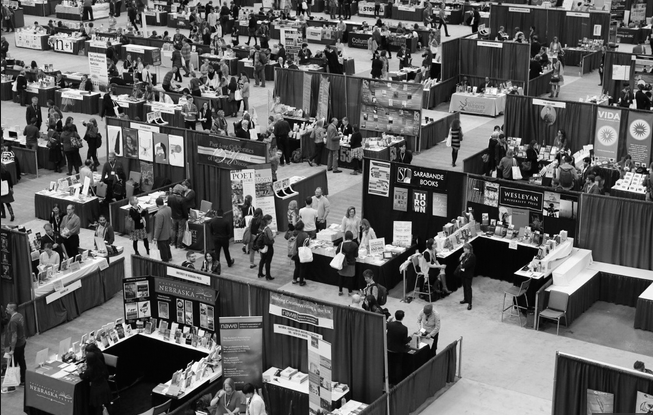
J: I love the way you put that. Facing a sphinx. Now I’m thinking of The Neverending Story and seeing how I could go on an AWP quest and level up every time I face a fear. I’m pretty sure this would be a pretty fun AWP-game.
C: I think you’re onto something there, Jenniey.
Talking to Agents/Publishers aka Small Talk All Around
J: Oh my goodness. Even the title of this one gives me that very particular, “I need to crawl under a table now” feeling. Last year I did not see a single person the whole time I was at AWP. Afterward, people kept saying, You were there, Jenniey? I didn’t see you!
C: I have to say, as I was new the the whole concept of AWP, I was nervous about that too. Would I make a fool of myself? I’m short–would I get lost in the crowd? How do I even approach a booth/person/place/thing?
I ran into my old undergrad professor literally five minutes in on the first day, and my worries were quelled. I could do it. I felt a little bit like a robot by day three–but I soaked in every bit of it. I have the magnets and pins to prove it.
Budgeting AWP
J: I’m not a spender. I don’t buy things. So, this is no biggie. I was more concerned about food. What do other people eat at AWP? Last year, I took a bunch of granola bars and just nibbled them from my bag like a chipmunk.

Oh, if only Chelsea’s tote knew how full it would get…
C: Ha. Let’s just say I pretended all was alright every time my card was swiped. I had no self-control. But I have full bookshelves and no regrets.
J: Be honest. How much did you spend?
C: You see… I tried to hold out until day three to buy things. I gave it my best effort. But I hit triple digits. Which, as a grad student, is basically flirting with a guillotine. I did get a ton of free literary magazines though. No subscriptions, so, that counts as budgeting, right?
Networking
J: Matt Bell addressed this on facebook. Karen Craigo was smart enough to blog about it; read the whole quote at her blog.
“Since it’s that time of year again, here’s the only AWP advice I have to offer for anyone nervous about meeting new folks or “networking,” which will also work for literally any other social situation: When in doubt, just be more interested in other people than in yourself.” −MB
Pre-AWP Emotions
C: The first time I went to AWP, I was 22 and just a young sprite in my first year of grad school. I had no idea what to expect but I was extremely excited for the opportunity. It felt like it was just my luck that I moved to the Twin Cities the year AWP happened here.
J: “Just my luck…” Those were my feelings as well. But, I think our inflection was vastly different. What are your Pre-not-going-to-AWP-this-year emotions? Personally, I am so, so grateful to stay home and experience it through Twitter and Facebook.
C: Could I just describe it as a one big sigh of disappointment?
Seriously though, I think it would be different if I wasn’t involved with Water~Stone. I now have a larger view of the literary world and simply, I had a good time running the social media and experiencing all of these fun things through that lens. I’d love to be there in the action and document as much as I can for myself and WSR. Plus, I’d be able to relate to more people than now that I have experience and know the lingo of the world. I wouldn’t be a run of the mill grad student there.
J: You know, I think that is great. I can sincerely say that I wish you could be there this year.

Post AWP Emotions
J: I really, really love my tote bag.
Last year, I felt disappointed in myself when it was over. I had not done enough, met up with anybody, and one day I literally just drove to the library instead and wrote for like five hours.
C: Sad. But my aching body was relieved. Seriously, it was fantastic. I couldn’t have asked for a more perfect AWP. Upon reflection, I would do things differently–but I didn’t know the literary world much then. I’m the kind of writer that wants to meet and chat with everybody I can. Every experience and journey is vastly different. Whether hearing these stories on panels, at a booth, or on an offsite event, all enhanced my knowledge of the literary world I just discovered. AWP is the place where writers of all kinds can come together be around others who simply get what it’s like, no matter what experience level.
J: What would you have done differently, Chelsea?
C: I feel like I could have made more connections. I talked a lot, and I did have wonderful chats with people (there were a lot of Michiganders), but I glossed over getting into deeper discussions that might have benefited me. At the same time, I not sure I was ready for that then. I didn’t have any of the experience I have now. If I tried to talk about the workings of a literary journal, I would have sounded like somebody who was in way over her head.
Maybe I could have taken some time to step out (when the weather wasn’t being fickle) for a breather. I may be an extrovert come AWP time, but I think we both agree that people are exhausting.
To any new AWP goers: take breaks. You’ll thank yourself for allowing some time for decompression away from the madness.
J: I have to second your “take breaks.” I wrote a perfectly great essay in the library the day I stayed away.
If you are uncomfortable in these sorts of situations, but feel you must be there anyway, see if you can snag someone like Chelsea to go with you–better yet, for you.
Authors:

Jenniey Tallman
Former Assistant Managing Editor
Originally from Virginia, Jenniey is temporarily living in Northern Manitoba with her husband and their 3 sons. Recent work can be found in the Electric Literature, Austin Review, DIAGRAM, Slice Magazine, and Nashville Review, among others. She completed her MFA in poetry at Hamline, where she also taught and assisted with the literary journals. Find her online at jennieytallman.com.

Chelsea DeLong
Former Assistant Managing Editor
Chelsea DeLong is currently a graduate student at Hamline University in St. Paul, graduating in May with her MFA in fiction. Originally from Michigan, Chelsea has found her home in the Twin Cities and all of its rich literary history. She can usually be found writing her novel, cooking without recipes, and adding another book to her ever growing library.
A September Summer: Refections of July
A September Summer: Refections of July

It’s been hot here the past few weeks. Like summer-hot. 90+ degree September days will make anyone reflect on their most recent July.
Somewhere between July barbecues, vacations, and family get-togethers we host a little space for writers, the Water~Stone Review Summer Writing Workshop on the campus of St. Olaf College, in Northfield Minnesota. An easy 45-minute drive from the Twin Cities, the WSR Writing Workshop provides a great opportunity to work with nationally-renowned authors close to home while also having some relaxation and fun.
Within the workshop, we carve out a special Publishing Panel for our participants, and invite folks from all walks of the industry to join us in a discussion about those waters and all its tributaries. Participants on this year’s panel were Mary Logue and Esther Porter. The panel was moderated by assistant managing editor, Sophia Myerly.
In these last few days before our autumn bursts into our twentieth season of submissions, readings and events, and pumpkin spice, we take this moment to recall a day at our Summer Writing Workshop this past July.
Meet the Editorial Board: Sophia Myerly
Meet the Editorial Board: Sophia Myerly
For twenty years, Water~Stone Review has been a collaborative passion project of students, faculty, and staff. While it is a staff member who holds the position of managing editor (Meghan Maloney-Vinz), and esteemed faculty (Katrina Vandenberg, Patricia Weaver Francisco, and Sheila O’Connor) who serve each issue as section editors, it is our current MFA (creative writing) students who work as invaluable editorial board members and graduate assistants. Led by the faculty editors in a semester-long course, our editorial board members learn the art of careful consideration and in doing so curate the beautiful writing in our journal each year.
In this series of blog posts we introduce you to some of our incredible and accomplished student editors. In this post we meet Sophia Myerly.
Hello! I’m Sophia, the new assistant managing editor for the literary journals of the Creative Writing Programs at Hamline University. I’m a second-year student in the MFA program here, focusing on creative nonfiction with a deep passion for poetry. My own writing draws a lot of energy from the natural world, stemming from the fact that I live next to a National Scenic Riverway and find my everyday life influenced by many species and environmental considerations.
While I have just finished my first year of study in the MFA in Writing program at Hamline, I have been involved with the Hamline CWP for nearly six years. I graduated with a BFA in Creative Writing with a double minor in English and linguistics from Hamline in the spring of 2016. During my time in the BFA program, I had the unique opportunity to gain experience with the world of literary journals through the efforts of Katrina Vandenberg, the founding editor of Runestone Literary Journal. Runestone came into existence during my undergraduate years at Hamline, and I served as a member of the student editorial board for Creative Nonfiction for the inaugural volume of the journal. The experience was so rewarding and beneficial that I came back as an assistant editor for creative nonfiction for volume 2.
Runestone was created with Water~Stone Review’s literary tradition in mind, and it was through my time in the BFA program that I became familiar with the work that Water~Stone does in the literary community. The opportunity to gain further experience through reading and discussing submissions, learning more about the literary publishing world, and acquiring further editing skills through participating in the Water~Stone class was one of the biggest reasons why I chose to attend the Hamline MFA program. I served on the CNF editorial board for our upcoming issue, Volume 20, and am honored to now be working on the production and promotion of Volume 20 as assistant managing editor in addition to working with Runestone and the Hamline MFA’s in-house literary journal, Rock Paper Scissors.
Reflecting on my experiences working on Water~Stone Review as a student editor, I feel a deep sense of gratitude for the lessons I’ve been able to learn as a writer and an artist by looking at pieces of writing with an editorial eye. In looking at the work of others, I’ve gained the perspective to see my own idiosyncrasies as a writer more clearly and thus work towards writing with greater clarity and precision. Now, as I work on the journal from the production side, I’m also learning about the ways that design and visual art can interact with text to create thought-provoking intersections. Finding these connections requires a deep consideration and care for the work of all artists involved, and we take our roles as supporters of diversity in voice and form very seriously. All together, this experience calls for a ‘learning mindset’—a blessing for any writer who wishes to practice literary citizenship and be a meaningful contributor to this phenomenal community. I’m thankful to have the opportunity to gain these experiences during my MFA studies, and I look forward to what’s ahead.
Sophia Myerly
Assistant Managing Editor for the Literary Journals of the Creative Writing Programs at Hamline University
A transplant from the fields of Iowa to the deep forests and flowing waters of Minnesota, Sophia delights in the natural world and considers it to be her writing muse. She is fascinated by the complexities of the written word and the hidden marvels of the brain, which explains why she savored the opportunity to pursue a double major in Creative Writing and Psychology with a double minor in English and Linguistics at Hamline. Equipped with a deep, reverent appreciation of research and heavily laden bookshelves, Sophia is currently delving deeper into her studies of creative nonfiction in the Hamline MFA program.